Who among you has ever sat down with a spreadsheet, weighed broccoli down to the gram, and logged every bite into an app, only to end up three weeks later with an empty phone and the feeling that it's all pointless? Precise calorie counting sounds logical, but in real life it's a battle that hardly anyone wins. The good news is that mathematical perfection isn't a requirement for success. Real, sustainable body transformation is built on something completely different — consistency, pattern recognition, and small, repeatable steps.
In this article, we'll look at why obsessing over exact numbers is a dead end, and what actually works instead. We'll show you concrete approaches used by people with long-term sustainable results, and explain how the technology you carry in your pocket can help you with it.
Why precise calorie counting doesn't work in practice
Calorie counting is based on the assumption that we know the exact energy value of everything we eat. The reality is different:
- Labels aren't accurate — manufacturers are legally allowed a certain margin of error, so the real value can differ by tens of percent.
- Home-cooked meals are hard to estimate — how much oil did you actually use in the pan? How many grams is your grandmother's sauce?
- It's time-consuming — weighing, logging, searching for items in a database. After a few weeks, this administrative burden wears out even the most motivated people.
- It leads to black-and-white thinking — one "imperfect" meal often triggers a feeling of failure and giving up on the whole effort.
The result is that people either quit altogether or develop an unhealthy relationship with food based on anxiety over numbers. Neither will help you in the long run.
The solution: focus on habits, not math
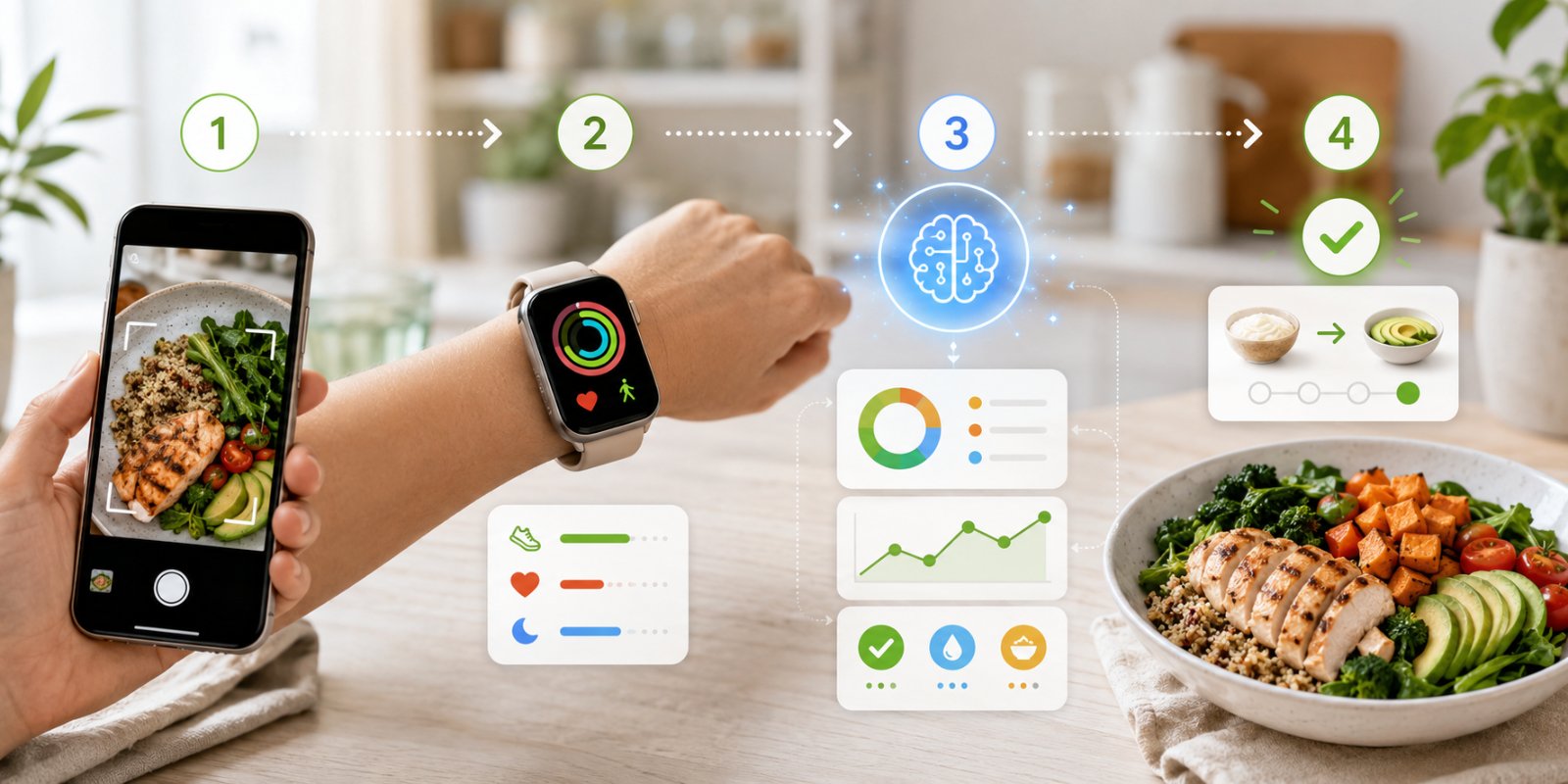
Instead of chasing the perfect number, ask yourself: which habits help me in the long run, and which ones hurt me? Your body doesn't respond to a single meal, but to what you do repeatedly, week after week, month after month. That's why a combination of four principles tends to work well, which we'll break down step by step.
1. Tracking without friction
Classic text-field logging is the biggest obstacle to consistency. If you use visual tracking with food photos instead, you eliminate the need to search for ingredients in databases or weigh everything to the gram. You take a photo of your plate, the system estimates the nutritional values, and you move on. Thanks to its simplicity, this approach keeps working for months, not just the first motivated week.
2. Weekly coaching instead of daily panic
Daily numbers fluctuate — influenced by water retention, sleep, the menstrual cycle, stress, or just random scale variation. If you focus on weekly trends, natural fluctuations won't throw you off, and you'll get a much more realistic picture of where you're actually heading. A weekly view also lets you respond to patterns rather than individual blips.
3. Specific micro-changes instead of drastic overhauls
Radical diets fail because they require changing too much at once. A series of small, targeted adjustments works much better, for example:
- Swapping your cooking fat (say, butter for a smaller amount of olive oil).
- Shifting protein intake closer to your workout or to the morning hours.
- Fine-tuning portion sizes based on how you actually feel after eating.
- Adding one serving of vegetables to lunch without having to change your whole diet.
These micro-changes are easier to sustain because they don't require perfection — just a small improvement to a real habit you already have.
4. Activity tracking via wearables
Smartwatches and fitness bands today record steps, resting heart rate, sleep, and workout intensity without any manual logging. This data fills out the picture of your energy expenditure and helps uncover patterns — for example, that weeks with fewer steps regularly coincide with weight stagnation. Combining activity data with weekly eating trends gives you much more accurate and far less stressful feedback than any single calorie balance ever could.
How the FitAid app supports this approach
These exact principles are what shaped the design of the FitAid app. Instead of endlessly entering ingredients into forms, all you need to do is take a photo of your meal — the app recognizes the nutritional values from the photo and saves them without any manual weighing or database searching. This removes the biggest barrier that makes people give up on tracking their diet.
FitAid also offers AI coaching on a weekly basis. Instead of a graph full of daily ups and downs that often just makes people anxious, you get specific recommendations: what to adjust next week, which portion to cut down, when to shift your protein intake. This is exactly the kind of feedback focused on micro-habits, not the chase for an exact number.
On top of that, the app connects data from wearable devices, so you have your movement, sleep, and nutrition all in one place, and the AI coach can base its recommendations on a broader context — not just on what you ate.
Practical summary
If you've been trying to achieve calorie perfection and it's worn you out, you're not alone — and more importantly, it's not necessary. A different combination works better in the long run:
- Track your food in a way that takes no more than a few seconds a day.
- Evaluate progress in weekly, not daily, intervals.
- Make small, specific habit adjustments based on real feedback.
- Complete the picture with movement and sleep data from wearables.
Your body doesn't need a calculator — it needs consistency, realistic adjustments, and a routine you can actually live with for a year, not just three weeks.