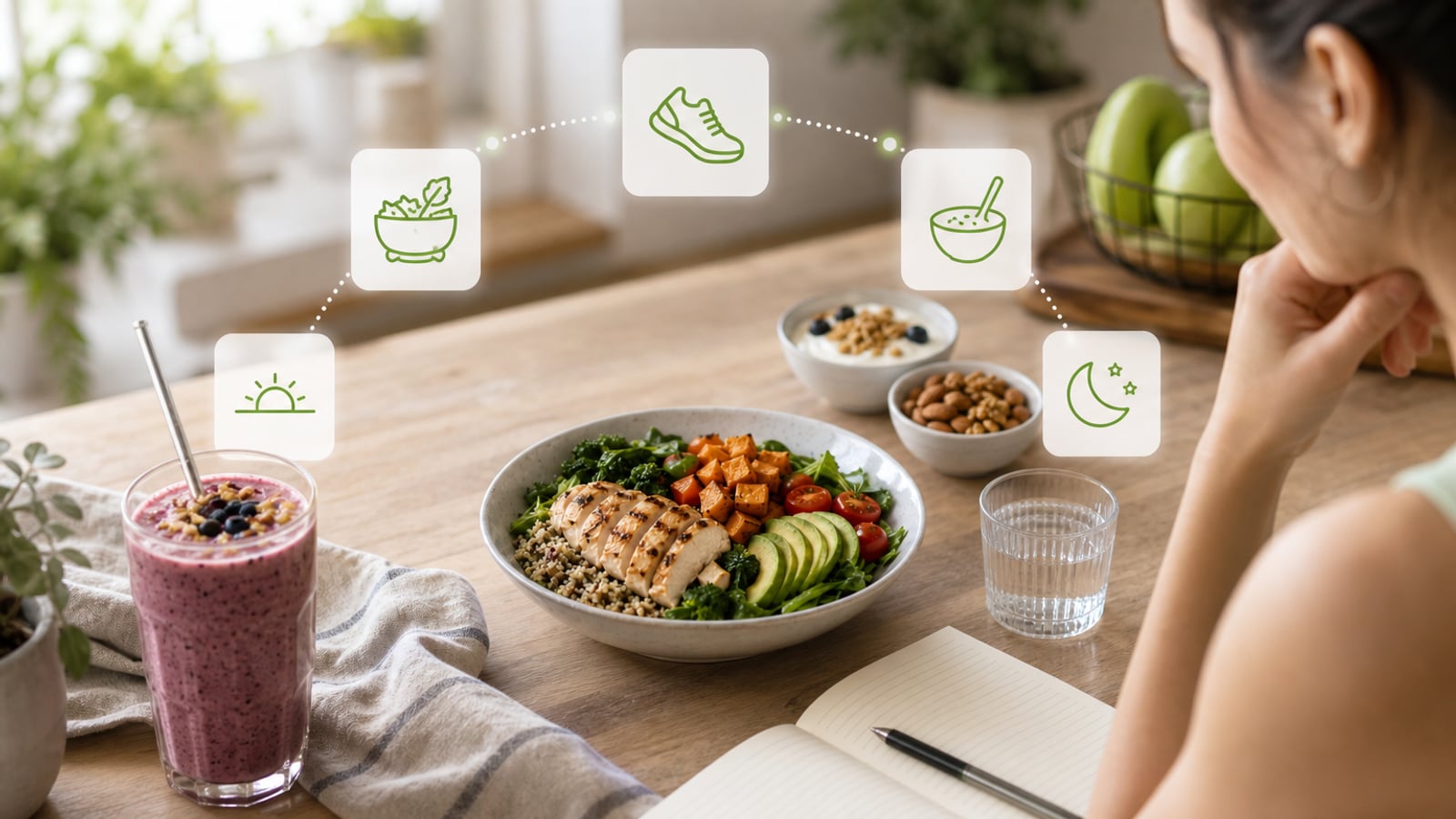
When you find yourself reaching into the cookie jar for the third time in the evening, it's easy to blame weak willpower. But the reality is often different: what happens at 8 p.m. is largely a consequence of what did (or rather didn't) happen since morning. Skipped meals, long gaps between portions, and accumulated fatigue together create conditions in which cravings appear almost automatically. Before tackling the evening itself, it makes sense to look at the whole day as one connected whole.
FitAid in this regard doesn't serve as a tool for restriction, but as a way to get an overview of when and what you actually eat throughout the day – and to notice patterns that repeat without you normally noticing them.
Why evening cravings aren't just a matter of weak willpower
Food cravings are often simplified down to a lack of discipline. Physiologically and practically, however, it's much more complex. The body reacts to how much energy and nutrients it received throughout the day, and if the balance is uneven – for example, a large portion of calories arrives only after 6 p.m. – the brain and hormonal system push to replenish energy at the moment that's least convenient from a planning perspective.
There's also a psychological side to it: after a demanding day, the ability to resist impulses decreases, because the brain's decision-making capacity is to some extent limited and is depleted by evening. This isn't a character flaw, but a common mechanism that you can work with once you know about it.
How skipped meals are related to evening hunger
One of the most common situations that contributes to evening overeating is skipping or significantly cutting back on a meal during the day – typically breakfast or lunch. It may seem like it saves calories, but in reality it often just shifts the energy need to later, when it's harder to control.
- Skipped breakfast: hunger builds up and translates into a larger amount of food in the afternoon or evening.
- Shortened or rushed lunch: the body doesn't get enough energy or a feeling of fullness, so hunger returns sooner and more intensely.
- Long gaps without food: the longer the break between meals, the harder it is to make calm, considered decisions in the evening.
These connections are easy to miss if you don't record your individual meals anywhere. The day then appears as a series of unrelated events, rather than a whole with its own logic.
Fatigue as a hidden factor
Physical and mental fatigue play a key role in evening snacking, even though it's discussed less than food itself. After a day full of work tasks, decision-making, and problem-solving, it's common to reach for food as a quick form of relief – it's not primarily about hunger, but about the need for reward or release.
If fatigue is also combined with insufficient energy intake during the day, the resulting combination is almost predictable: the body and mind both look for something that quickly boosts energy or mood. Sweet or fatty food satisfies this need instantly, even though it doesn't solve the problem in the long run.
How to get an overview of how meals are distributed throughout the day
The basic step in understanding your own patterns is to see how meals are actually distributed throughout the day – not how you remember it or how you wish it were. In practice, this means logging meals in a way that isn't time-consuming and can be kept up even on ordinary, hectic days.
In FitAid, you can log a meal in several ways, depending on what suits the moment: by text, by voice, or by taking a photo of your plate, where the app recognizes the meal and breaks it down into individual components with an estimated portion size. The estimate from a photo is approximate, and each item and portion can be adjusted as needed – it's a tool for quick logging, not precise measurement. For meals that repeat, such as a typical breakfast or a work lunch, you can save them to favorites and simply reuse them next time, which makes logging easier even on days when there isn't much time or energy for it.
Because individual meals are saved over time, after a few weeks it becomes visible what a typical day looks like – when meals are missing, when they pile up toward the evening, or when the same situation repeats before a more demanding day. The weekly AI coach then, based on the logged meals, offers recommendations for small, manageable changes to everyday habits – explaining the connection between what repeatedly shows up in the data, a specific smaller adjustment, and how to try it out on a normal day. It's not a guaranteed result or a real-time reaction, but a regular prompt for reflection that you can try out for yourself.
Practical steps toward a more stable day
Before tackling the evening itself, try focusing on how meals are distributed throughout the day. Here are a few specific steps worth trying:
- Log meals as they actually happened – including small snacks or just coffee with something on the side.
- After a week, check whether a regular pattern emerges, for example a late or skipped lunch on certain days.
- If you notice that certain days lead to more pronounced evening snacking, try deliberately planning a heartier lunch or afternoon meal on those days.
- Keep an eye on whether the situation repeats even after a small adjustment, and adjust again if needed – small steps tend to work better than drastic overnight changes.
This approach doesn't require tracking every detail down to the last gram, but rather building a regular, readable overview of how eating actually unfolds throughout the day.
Summary
Evening cravings rarely come out of nowhere – they're usually a reflection of how the whole day was structured, how much food and energy went into it, and how much fatigue had built up. Instead of judging your own willpower, it makes sense to look at the bigger picture: when meals are missing, when they pile up, and what keeps repeating. Regular, low-effort meal logging – whether by text, voice, or photo – makes it possible to gradually uncover these connections and work with them through small, sustainable steps.